Osteoarthritis
OA, degenerative joint disease
Chronic conditionThe most common type of arthritis. The cartilage that cushions the ends of bones breaks down over time, causing pain and stiffness, most often in the knees, hips, hands, and spine.
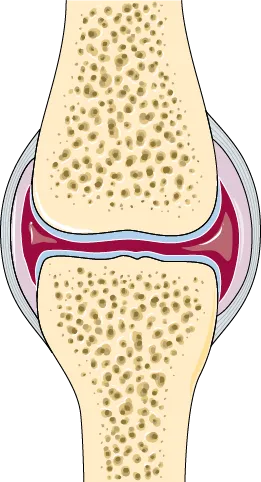
What happens
Osteoarthritis affects the whole joint. Cartilage thins, the bone underneath changes and can form bony spurs, and the joint lining can become mildly inflamed. It isn't simply wear and tear. Age, genes, past injury, joint alignment, body weight, and metabolic health all play a role. Unlike rheumatoid arthritis, it isn't autoimmune, and morning stiffness is usually brief.
Who gets it
Osteoarthritis becomes more common with age, especially after 50, and is more common in women, particularly after menopause. Hand and knee osteoarthritis are especially common in women. Past joint injuries, joint-heavy work, family history, and higher body weight raise the risk.
Common signs
- Joint pain that's worse with use and better with rest
- Stiffness in the morning or after sitting that usually eases within 30 minutes
- Less range of motion
- Grinding, clicking, or crackling in the joint
- Hard, bony bumps on the finger joints
- Pain at the base of the thumb
- Mild swelling after activity
- A knee that feels unstable or gives way
Labs to ask about
- A physical exam and history of how the pain behaves
- X-rays of the affected joints
- CRP, ESR, rheumatoid factor, and anti-CCP if inflammatory arthritis is possible
- Uric acid if gout is possible
- Joint fluid testing if a joint is very swollen
How it's usually treated
- Exercise and physical therapy, especially strengthening, which are the first-line treatment
- Topical NSAIDs, or oral NSAIDs used with care
- Steroid injections into the joint for flares
- Braces, splints, supportive shoes, or a cane
- Joint replacement for severe hip or knee osteoarthritis
Supportive steps to discuss with your provider
- Stay active. Low-impact movement such as walking, cycling, swimming, or tai chi often eases pain.
- Build strength in the muscles around the joint.
- Ask whether a change in body weight would ease load on your knees or hips. Even modest changes can help.
- Glucosamine, chondroitin, and turmeric have mixed evidence. Ask before starting them.
- Ask before regular NSAID use if you have kidney, stomach, or heart problems.
See a doctor promptly if you have
- A single hot, red, very swollen joint with fever: get same-day care (possible infection)
- Sudden severe pain or trouble bearing weight after a fall: get same-day care
- Morning stiffness lasting more than an hour, or swelling in many joints
- Joint pain with a rash, fever, or weight loss
- Pain at night or at rest that keeps getting worse
Related conditions
Rheumatoid arthritis
The immune system attacks the lining of the joints, causing painful swelling that can damage cartilage and bone if untreated.
Learn more →Psoriasis & psoriatic arthritis
An immune-mediated condition in which skin cells build up too quickly, forming thick, scaly patches. Up to about 1 in 3 people with psoriasis develop psoriatic arthritis.
Learn more →Osteoporosis
A condition in which bones become thinner and weaker, so they break more easily. It usually causes no symptoms until a bone breaks.
Learn more →Perimenopause and menopause
Menopause is the point 12 months after your last period, when the ovaries have stopped releasing eggs. Perimenopause is the years of shifting hormones before it, when most symptoms begin.
Learn more →
Wondering if your symptoms fit a pattern?
Dr. Lesher is a naturopathic doctor who specializes in women's autoimmune and chronic conditions. Since 2020, she has helped more than 900 patients overcome and heal from their conditions.